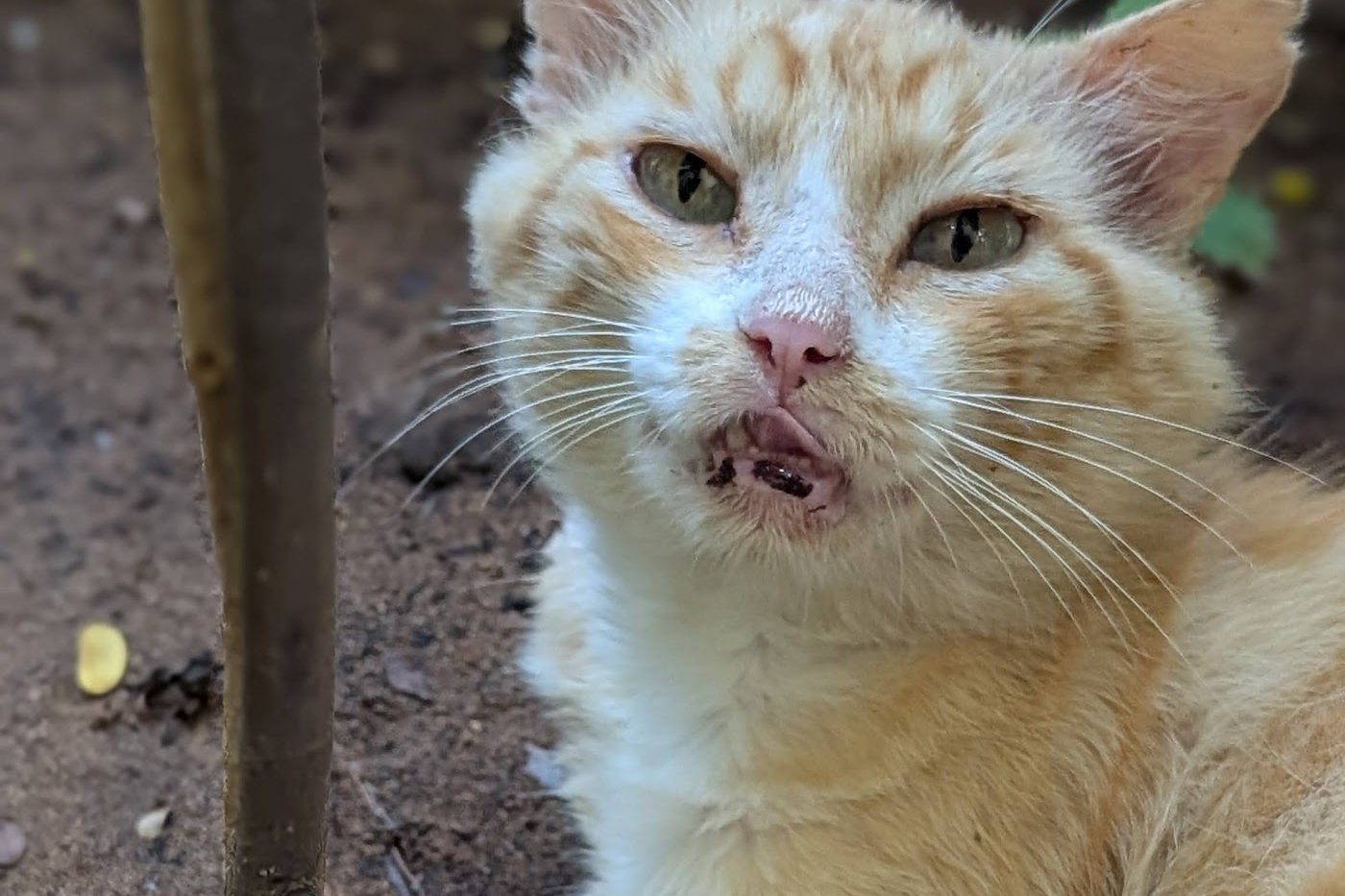
When I first came to the house, Ninja was skin and bone. A little orange tomcat, missing fur, covered in wounds, fighting the other cats every night: you could hear him screaming. He wouldn’t let me anywhere near him. He clearly hadn’t met many kind humans for a while.
Not everyone who loves cats can afford to feed every cat that turns up, and some cats end up going without. Ninja was one of them.
So I started feeding him at night. Before long he was coming to my door, then sleeping at my door, because he knew I was there. Little by little his fear of me faded.
Now he’s the talk of the town. Friends and family of the house come by and ask, “Is that Ninja?” and then, “He looks so good!”
What Ninja taught me
Loving cats and affording them are different things. In a place where money is tight, a person can care deeply about every cat in the yard and still not be able to feed them all, or pay for sterilisation. That’s not a failure of love. It’s exactly the gap a care network could fill: someone else might be able to share the cost, or the food, or the vet bill.
One person can change a cat’s life, and then leave. Ninja is thriving because someone had the time and the means to feed him every night. But I’m only here for a while. When I go, who will know that Ninja eats at night, or that he was once in such a bad way? That’s the whole reason for Stray Cats: the cat outlives its caretakers.
When feeding stops, cats notice fast. On the hard days, when Saibo was ill and when I was sick myself, feeding slipped. The cats started hunting and biting almost immediately. Being fed regularly is the difference between a calm cat and a desperate one.
Do you know a cat like Ninja, one who was turned around by someone who simply kept showing up? I’d love to hear about it.